From foundations to quality systems
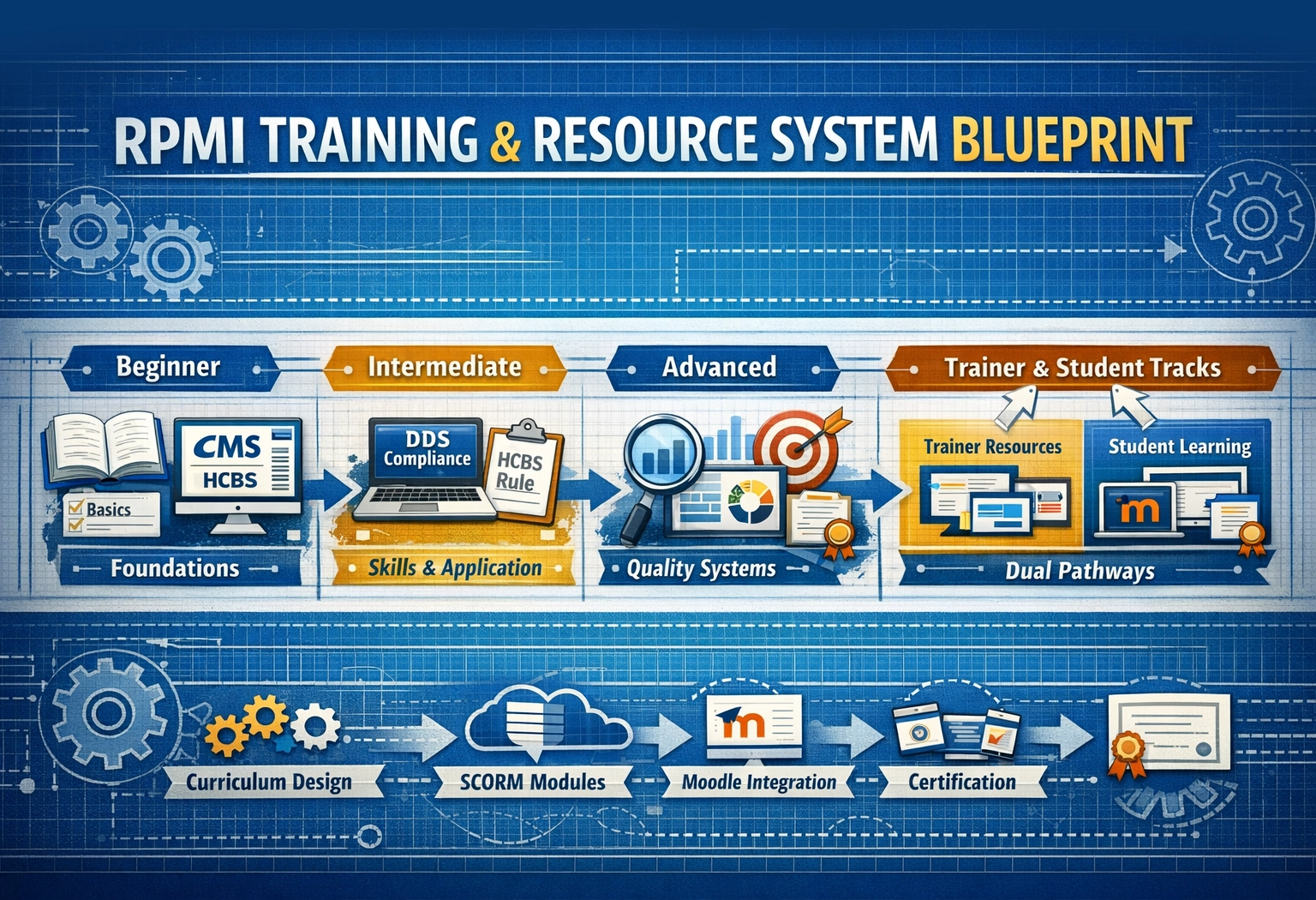
RPMI training builds in four stages, with resources for both trainers and learners. Select a stage to see what it covers and go straight to the matching resources.
Select a stage to see what it covers.
Foundations
Learn the basics of home and community-based services (HCBS): how residential supports are organized, how Medicaid funds them, and the key terms used in residential programs.
Skills and application
Apply the rules in daily work: DDS requirements, the HCBS Settings Rule, individual rights, safety and incident reporting.
Quality systems
Use data to monitor and improve services: quality measures, monitoring and evaluation, and the research behind good practice.
Two pathways: trainers and learners
Trainers use these resources to prepare sessions and onboarding. Learners use them to study, review and prepare for module quizzes and the final exam.
Student resources
Resources for Learners and Trainers
Your RPMI learning links, plus a curated directory of credible, public DDS, CMS, HCBS, DSP and residential services resources for policy review, study, onboarding and trainer preparation.
How RPMI builds and delivers training
Every RPMI course follows the same path, from a written curriculum to a certificate anyone can verify.
Select a stage to see what it covers.
Curriculum design
Courses start from written curricula built around DDS and CMS requirements and real residential practice.
Interactive modules
Each module combines short lessons with a practice scenario that learners complete before the module quiz, so skills are applied, not just memorized.
Go2Class learning platform
Courses run on Go2Class, RPMI’s Moodle learning platform, where learners study, practise and take their quizzes and final exam, combined with in-person sessions.
Certification
Learners who score at least 80% on each quiz and the final exam receive a certificate, valid for 2 years, with a unique ID anyone can check online.
Your RPMI learning tools
Start with official sources
- Use the official CMS / Medicaid and ACL links first when building policy, curriculum or compliance-sensitive training.
- Use the PDF section for downloadable references to assign as pre-work or trainer packets.
- Use the video and webinar section for short study sessions, lunch-and-learns or facilitated discussion.
- Use the state DDS / IDD agency portals when a trainer needs jurisdiction-specific examples or a policy comparison.
Learner starter sequence
- Medicaid HCBS overview
- HCBS Final Regulation and HCBS provisions
- ACL person-centered planning
- CDC long-term care safety resources
- SAMHSA trauma-informed care
- NADSP ethics and competencies
Trainer / research sequence
- CMS HCBS quality and measures
- DSW Core Competency Project
- ACL DCW Strategies Center
- NCI / NASDDDS quality data
- DOJ / ADA Olmstead resources
- State DDS / IDD agency portals
Curated DDS, CMS, HCBS, DSP and residential services links
For learners, trainers, supervisors, program managers, directors and quality staff.
1Official CMS / Medicaid core resources
Highest-priority federal pages for HCBS rules, quality, authorities and workforce training.
- Home & Community Based Services (opens in a new tab)Website
Best starting point for HCBS basics, authorities, trends and federal orientation.
- HCBS Final Regulation (opens in a new tab)Website
Core HCBS settings-rule landing page with related links, updates and implementation materials.
- HCBS Provisions in the 2024 Access Final Rule (opens in a new tab)Website
Current HCBS policy changes on person-centered planning, incident management, grievances, worker payment transparency, waiting lists and measures.
- HCBS Guidance & Additional Resources (opens in a new tab)Website
Official CMS technical assistance hub for letters, FAQs, bulletins and HCBS guidance.
- HCBS Quality (opens in a new tab)Website
Overview of CMS quality oversight across HCBS and LTSS delivery systems.
- HCBS Quality Measures (opens in a new tab)Website
Detailed measure page for HCBS CAHPS and other HCBS / LTSS measures.
- HCBS Health and Welfare (opens in a new tab)Website
Useful for incident management, abuse and neglect prevention, and participant safeguards.
- HCBS Authorities (opens in a new tab)Website
Federal overview of the 1915(c), 1915(i), 1915(j) and 1915(k) pathways.
- 1915(c) HCBS Waivers (opens in a new tab)Website
Core page for waiver basics, state flexibility and health and welfare responsibilities.
- 1915(i) State Plan HCBS (opens in a new tab)Website
Useful when teaching state-plan HCBS options and targeted populations.
- Self-Directed Services (opens in a new tab)Website
Federal overview of self-direction and person-controlled service delivery.
- Online Training for Self-Directed HCBS (opens in a new tab)Website / Training
Free CMS-linked training on recruiting, selecting and retaining direct service workers in self-directed HCBS.
2Official PDFs, fact sheets and downloads
Downloadable references for trainer packets, learner reading lists and policy binders.
- Final Rule: Home and Community-Based Services (CMCS Informational Bulletin) (opens in a new tab)PDF
Historic 2014 HCBS bulletin summarizing the final rule and implementation transition.
- HCBS Final Rule Fact Sheet (opens in a new tab)PDF
Quick explainer on key settings-rule provisions and person-centered planning expectations.
- HCBS Final Rule Slides (opens in a new tab)PDF
Slide deck useful for trainer-led orientation to the 2014 settings rule.
- Access Final Rule HCBS Payment Adequacy Slides (opens in a new tab)PDF
Recent federal slide deck on HCBS payment adequacy under the Access Final Rule.
- No Wrong Door Key Elements (opens in a new tab)PDF
ACL guidance on person-centered counseling, governance, outreach and streamlined eligibility.
- DSW Core Competency Project (PDF) (opens in a new tab)PDF
Official Medicaid competency document for curriculum design and competency mapping.
- Practical Guide for Implementing a Trauma-Informed Approach (opens in a new tab)PDF landing page
SAMHSA implementation guide with a downloadable PDF for organizational practice.
- SAMHSA’s Concept of Trauma and Guidance for a Trauma-Informed Approach (opens in a new tab)PDF landing page
Foundational trauma-informed framework and principles for program use.
3ACL, community living and person-centered planning
For trainers covering person-centered thinking, access systems and community living policy.
- Administration for Community Living (ACL) (opens in a new tab)Website
Federal portal for disability and community-living policy, programs and resources.
- Person-Centered Planning (opens in a new tab)Website
ACL explanation of person-centered planning with linked reports and facilitator competency materials.
- No Wrong Door (NWD) (opens in a new tab)Website
National long-term services and supports access initiative centered on person-friendly systems.
- NWD Resources (opens in a new tab)Website
Resource hub with tools, guides and the key elements PDF.
- Building and Sustaining a No Wrong Door System (opens in a new tab)Website
Useful for trainers teaching access-system design and person-centered counseling.
- Strengthening the Direct Care Workforce (opens in a new tab)Website
ACL workforce page with links to federal training and workforce strategy materials.
- Direct Care Workforce Strategies Center (opens in a new tab)Website
ACL-funded center for recruitment, retention, data, financing and training strategy.
- Professional Training & Education (DCW Strategies Center) (opens in a new tab)Website
Curated training and education resources for direct care and DSP workforce strengthening.
- Data & Research (DCW Strategies Center) (opens in a new tab)Website
For trainers, quality staff and program leaders who need workforce evidence and reports.
- National Guidelines for Apprenticeship Standards for the DSP Occupation (opens in a new tab)Website
Helpful when exploring workforce ladders and apprenticeship-based development.
4Rights, integration, safety and trauma-informed practice
Public resources for rights protection, integration, long-term care safety and trauma-informed services.
- DOJ Statement on the ADA Integration Mandate and Olmstead (opens in a new tab)Website
Key civil-rights reference for community integration and least restrictive service expectations.
- DOJ Q&A on Olmstead, Employment, and Day Services (opens in a new tab)Website
For discussions of segregation, day services and community-based alternatives.
- CDC: Infection Prevention and Long-term Care Facility Residents (opens in a new tab)Website
Public long-term care safety and infection-prevention resource.
- CDC Disability and Health Multimedia (opens in a new tab)Website
Videos, webinars and podcasts for disability inclusion and health education.
- SAMHSA Trauma-Informed Care (opens in a new tab)Website
Current SAMHSA overview of trauma-informed care and the federal task force.
- SAMHSA Trauma-Informed Approaches and Programs (opens in a new tab)Website
Implementation examples and organizational principles.
- TIP 57: Trauma-Informed Care in Behavioral Health Services (opens in a new tab)PDF landing page
Well-known manual for structured study and trainer reference.
5DSP professionalization, ethics and workforce
For learners, trainers and supervisors building professional identity and workforce standards.
- NADSP Resource Library (opens in a new tab)Website
Broad resource hub for DSP ethics, competencies and workforce tools.
- NADSP Code of Ethics (opens in a new tab)Website
Essential ethics reference for DSP practice and trainer discussion.
- NADSP Services (opens in a new tab)Website
Overview of certification, training, curricula and accreditation offerings.
- NADSP Training (opens in a new tab)Website
Virtual and keynote training topics for organizations and trainers.
- NADSP Curricula (opens in a new tab)Website
Curriculum options on onboarding, code of ethics, supervision and informed decision-making.
- NADSP Onboarding Curriculum (opens in a new tab)Website
Useful benchmark for new-hire orientation structures.
- NADSP DSP Certification (opens in a new tab)Website
Reference point for national DSP credentialing language.
- The NADSP Competency Connection (opens in a new tab)Website
Helpful summary of the validated competency mindset for DSP work.
- NADSP HCBS Settings Rule Webinar (opens in a new tab)Webinar page
Trainer reference on DSP implications of the HCBS settings rule; access may depend on membership.
- Code of Ethics Train-the-Trainer Curriculum (opens in a new tab)Website
Trainer-oriented ethics curriculum from NADSP (fee-based).
6Research, data and performance measurement
Sources for quality oversight, evaluation, trend analysis and workforce research.
- National Core Indicators (NCI) (opens in a new tab)Website
Public performance measurement initiative for state disability systems.
- NCI-IDD: Who We Are (opens in a new tab)Website
Explains the NCI-IDD model, partners and use of people-driven data for quality improvement.
- NASDDDS National Core Indicators Page (opens in a new tab)Website
How states use NCI data on rights, inclusion, planning and safety.
- Institute on Community Integration: Direct Support Workforce (opens in a new tab)Website
Research and overview on DSP roles, turnover, recruitment, advocacy and supervision.
- Direct Support Workforce Solutions (opens in a new tab)Website
Consulting and strategy hub grounded in University of Minnesota workforce research.
- Impact Feature Issue on the Direct Support Workforce (opens in a new tab)Website / publication
Free ICI issue on workforce and community living trends.
- DirectCourse (opens in a new tab)Website
Widely used competency-based online curriculum platform connected to ICI.
- CMS DSW Core Competency Project (opens in a new tab)Website
Research-backed competency project supporting standardized workforce development.
7Selected state DDS / IDD agency portals
For jurisdiction scans, benchmarking and state-level comparison. Agency names vary by state.
- California Department of Developmental Services (opens in a new tab)State agency website
Major DDS portal with HCBS programs, directives, incident reporting updates and system initiatives.
- California DDS: About (opens in a new tab)State agency website
Mission, least restrictive setting language and system description.
- Massachusetts Department of Developmental Services (opens in a new tab)State agency website
Services, area offices, person-centered supports and NCI survey information.
- Connecticut Department of Developmental Services (opens in a new tab)State agency website
Support resources and abuse and neglect reporting links.
- New York Office for People With Developmental Disabilities (OPWDD) (opens in a new tab)State agency website
A major IDD services portal for comparison and policy study.
8Video, YouTube and webinar resources
Public channels and video pages for self-study, trainer assignments or facilitated discussion.
- CMS Official YouTube Channel (opens in a new tab)YouTube
Official CMS video channel linked from CMS digital media.
- CMS Digital Media (opens in a new tab)Website
CMS page linking to YouTube, social media and digital educational media.
- CMS.gov Live (opens in a new tab)Website / video portal
CMS live and archived events page connected to official YouTube coverage.
- ACL Official YouTube Channel (opens in a new tab)YouTube
Official ACL channel linked from ACL.gov.
- CDC Streaming Health (opens in a new tab)YouTube
Official CDC video channel linked from CDC-TV.
- CDC-TV (opens in a new tab)Website / video portal
CDC video portal with channel links and embedded videos.
- CDC Townhall: Understanding Enhanced Barrier Precautions (opens in a new tab)YouTube
Long-term care infection-prevention webinar from CDC.
- RTC Media YouTube Channel (ICI) (opens in a new tab)Website linking to YouTube
Research and Training Center on Community Living video collection.
- Research and Training Center on Community Living YouTube Channel (opens in a new tab)Website linking to YouTube
ICI reference page for community living video content.
External links change over time, and some webinars or training pages may require membership. RPMI reviews the most-used links periodically. Report a broken link on our Contact Us page.
Take the directory with you
Download the full RPMI External Resource Directory as a PDF for trainer packets and study.