Trainings
How RPMI Trains
The Residential Program Management Institute (RPMI) uses a policy-driven, experiential and performance-based learning model designed for adult professionals in residential human services. It integrates andragogy, real-time application and data-driven monitoring to build competency, not just knowledge.
Train → Practice → Measure → Improve → Certify
Andragogy approach (adult learning model)
Experience-based learning
Participants bring real workplace scenarios into the training environment.
Problem-centered approach
Learning focuses on solving real residential program challenges, such as incident response and medication errors.
Immediate application
Every concept taught is directly tied to on-the-job performance.
Self-directed learning
Participants engage in reflection, decision-making and peer learning.
Real-time in-program training
RPMI eliminates the gap between training and practice by embedding learning into real or simulated program environments. Staff are trained during active program operations or through realistic simulations.
Training flow: the core RPMI cycle
- Policy explanation
- Real scenario
- Hands-on practice
- Reflection
- Performance monitoring
Example
- Reviewing the policy
- Simulating a medication pass
- Completing MAR documentation
- Supervisor evaluation using compliance indicators
Staff are not just trained. They are validated in real performance conditions.
Practical and theoretical learning: a balanced model
Fire safety and evacuation
- Theory
- Fire risks and protocols
- Practice
- Live evacuation drill with timing and evaluation
Behavioral support
- Theory
- De-escalation principles
- Practice
- Role-play crisis intervention scenarios
Policy-based experiential training structure
Every policy is taught through the same five parts:
1. Policy purpose
- Why the policy exists
- Risks it prevents: legal, safety, ethical
2. Staff responsibilities
- Clear, role-based duties
3. Real-time scenario
- For example: resident refusal, medication error, behavioral escalation
4. Hands-on exercise
- Documentation (MAR, progress notes)
- Procedure execution (medication pass, evacuation drill)
5. Monitoring indicator
- A measurable compliance metric
- For example: incident report submission time, documentation accuracy rate
Integration with RPMI core modules
- Client rights protection
- Role-play advocacy scenarios and compliance audits
- Confidentiality (HIPAA)
- Data handling simulations and breach response drills
- ISP implementation
- Daily support alignment exercises
- Incident reporting
- Real-time report writing and supervisor review
- Infection control
- Hygiene audits and environment inspections
- Quality assurance
- Mock audits and corrective action planning
Policy-based practice training manual
The Residential Program Policy-Based Practice Training Manual provides experiential training for residential staff, using experiential learning and monitoring and evaluation (M&E) methodology. Its training cycle: policy explanation, real scenario, hands-on practice, reflection, performance monitoring.
Core residential program policies
- Client Rights Protection
- Confidentiality and Privacy (HIPAA)
- Individual Service Plan (ISP) Implementation
- Medication Administration
- Medication Documentation
- Incident Reporting
- Abuse and Neglect Reporting
- Emergency Response Procedures
- Fire Safety and Evacuation
- Behavioral Support and Crisis Intervention
- Infection Control and Hygiene
- Daily Progress Notes Documentation
- Staff Communication and Shift Handover
- Resident Supervision and Safety Monitoring
- Transportation and Community Safety
- Food Safety and Nutrition Support
- Program Data Collection and Monitoring
- Quality Assurance and Program Audits
- Professional Conduct and Ethics
- Staff Self-Care and Burnout Prevention
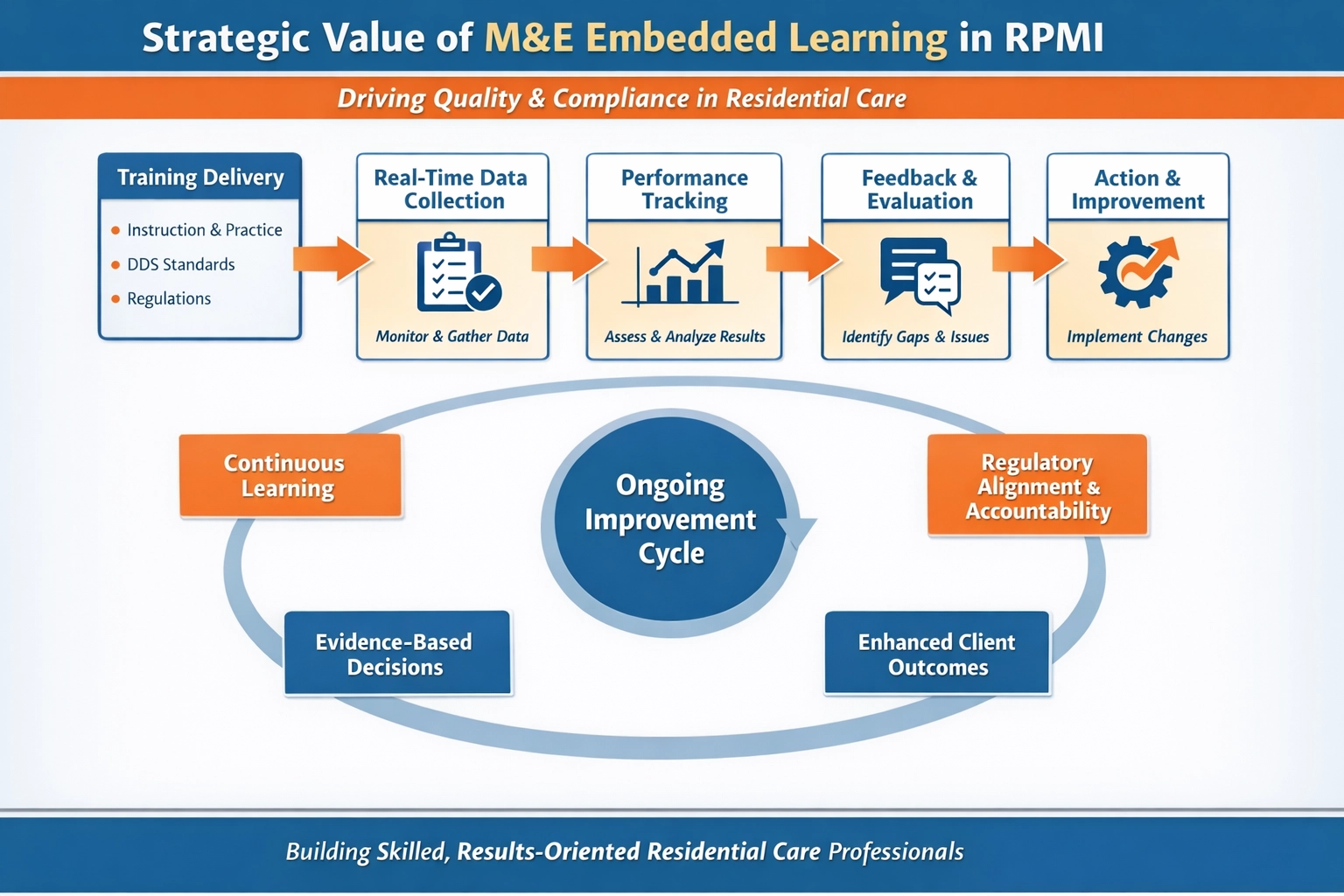
Monitoring and evaluation (M&E) embedded learning
RPMI integrates M&E directly into training because residential human services are data-producing environments, but not traditionally data-driven professions. Clinicians, direct care staff and program leaders generate vast amounts of documentation daily, yet often lack structured training in how that data is designed, interpreted and used for decision-making. RPMI intentionally closes this gap.
The core problem RPMI solves
Residential programs rely on
- Progress notes
- Medication Administration Records (MAR)
- Incident reports
- Behavioral tracking logs
- ISP documentation
However, most staff
- Use tools without understanding how they were designed
- Collect data without linking it to indicators
- Document events without measuring outcomes
Why M&E must be embedded, not separate
RPMI does not treat M&E as a separate subject. It is embedded into every policy, module and training activity.
- Administering medication
- generates compliance data
- Writing progress notes
- generates outcome data
- Responding to incidents
- generates risk indicators
Bridging the clinician–data gap
Clinicians and residential staff are service experts, but not trained data analysts. Key gaps RPMI addresses:
- Limited understanding of where indicators come from
- No structured knowledge of baseline data, indicator types or data tool design
- Weak linkage between documentation and program performance
Teaching the origin of indicators
Indicators are not random: they are derived from program design and policy requirements. They come from program proposals and regulatory frameworks, policy objectives (safety, compliance, quality care) and service delivery expectations.
Example
- Policy
- Medication Administration
- Indicator
- Percentage of medications administered correctly
- Source
- Safety compliance requirements
Understanding indicator types (RPMI framework)
Direct indicators
Measure exactly what is intended.
Example: Number of incident reports completed within 24 hours
Indirect indicators
Measure related outcomes.
Example: Reduction in repeated incidents
Proxy indicators
Used when direct measurement is difficult.
Example: Staff attendance as a proxy for program stability
Process indicators
Measure how activities are performed.
Example: Percentage of staff following proper documentation procedures
Input → output → outcome measurement
RPMI embeds results-based management thinking:
Data literacy for residential professionals
RPMI equips staff with practical data intelligence, not advanced analytics.
- Datasets
- Collections of structured program data, such as incident logs
- Data elements
- Individual fields: date, time, resident ID, event type
- Indicator components
- Definition, numerator and denominator, data source, frequency, target
Example: Incident Reporting Compliance Rate
- Numerator
- Reports submitted within 24 hours
- Denominator
- Total incidents
- Target
- 95% compliance
Tool design awareness
RPMI trains staff to understand, not just use, their tools: how MAR sheets are structured, why progress note formats matter, and how incident forms capture measurable variables.
Outcome: staff become more accurate in documentation, more consistent across shifts and more accountable in reporting.
Why each certification level learns M&E
RPMI aligns M&E competencies with career progression.
Residential Support Staff
Why M&E matters: They generate about 90% of raw program data.
What they learn
- Accurate documentation
- Understanding indicators tied to daily tasks
- Real-time compliance awareness
Impact: Improved data quality at the source
Program Manager
Why M&E matters: Responsible for program performance and compliance.
What they learn
- Indicator tracking and reporting
- Data-driven supervision
- Identifying performance gaps
Impact: Better decision-making and staff management
Residential Director
Why M&E matters: Oversees multiple programs and quality assurance.
What they learn
- Dashboard interpretation
- Audit preparation and compliance monitoring
- Program evaluation frameworks
Impact: Stronger organizational performance and regulatory readiness
Executive Leadership
Why M&E matters: Responsible for strategy, funding and organizational outcomes.
What they learn
- Outcome and impact analysis
- Resource allocation based on data
- Policy and system-level decision-making
Impact: Sustainable, scalable and high-performing programs
RHSDM: Residential Human Services Data Management
- Data collection
- Daily progress notes, MAR logs, incident reports
- Monitoring indicators
- Each policy includes a measurable compliance metric
- Performance dashboards
- Track staff competency and program outcomes
- Quality assurance integration
- Training feeds directly into audits and evaluations
Example
- Policy
- Medication Documentation
- Indicator
- Percentage of error-free MAR entries per staff member
- Action
- Staff retrained if performance falls below the threshold
Training is not theoretical. It is continuously measured, validated and improved.
M&E in training delivery
RPMI embeds M&E because data is the language of quality, safety and accountability in residential care. Without it, staff perform tasks but programs cannot measure success. With it, every action becomes measurable, improvable and accountable.
- Input Training sessions, materials, simulations
- Process Participation, engagement, exercise completion
- Output Skills demonstrated: documentation, response accuracy
- Outcome Improved staff performance and resident safety
- Impact Higher program quality and regulatory compliance
Evaluation methods
- Scenario-based assessments
- Documentation reviews
- Safety drills
- Written exams (CRPM certification)
Certification-linked competency model
Training feeds directly into CRPM certification outcomes.
Participants must demonstrate
- Operational competence
- Policy compliance
- Decision-making in real scenarios
Final validation includes
- Capstone project (program improvement)
- Scenario-based exam (80% pass score)
- Practical performance verification
RPMI learning philosophy
The RPMI model is built on one core principle: Train, Practice, Measure, Improve, Certify. Every trained professional is:
- Competent in real environments
- Accountable through measurable indicators
- Aligned with policy and regulatory standards
- Prepared for leadership through CRPM certification
See it in a CRPM course
Every CRPM track uses this model: practice scenarios, measurable indicators and an 80% pass standard.